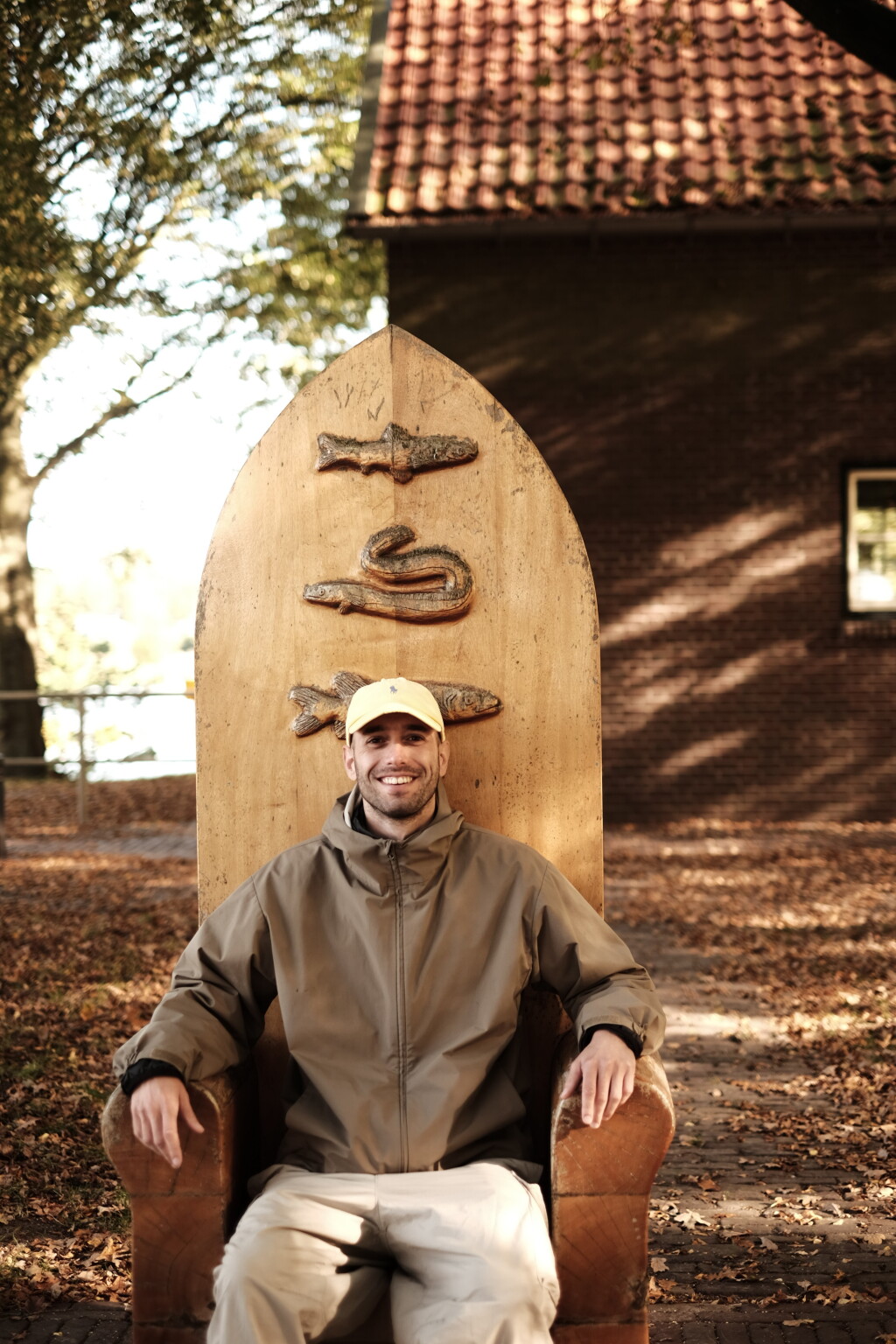
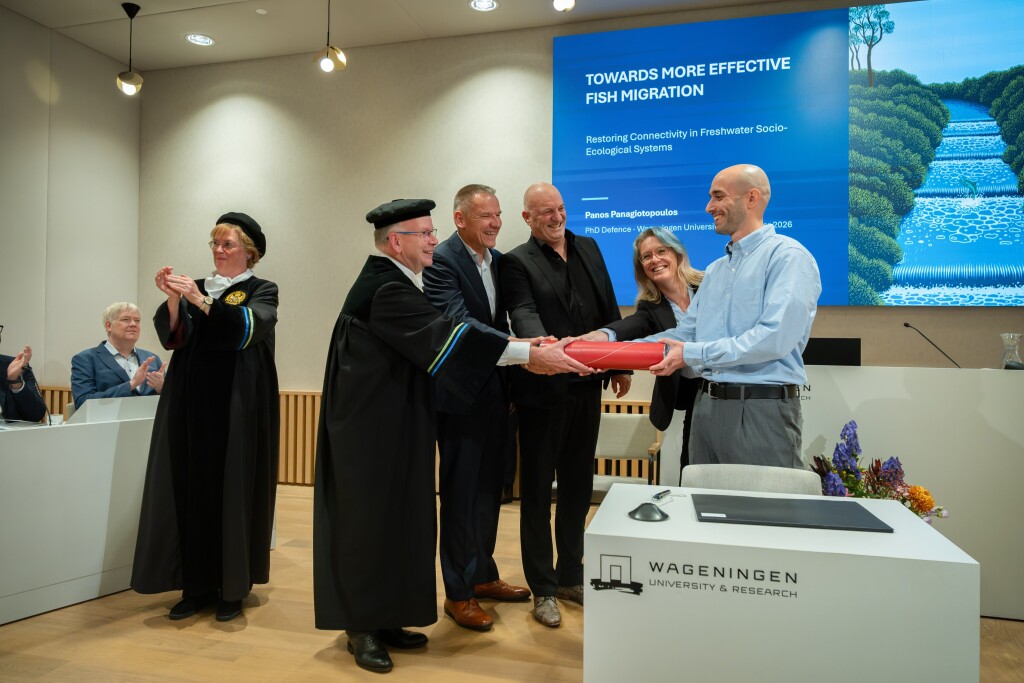
Panos Panagiotopoulos trained as a civil engineer, but underwater life drew him to rivers and the fish that depend on them. For his PhD at Wageningen University & Research, he set out to discover whether fishways really help fish get past dams and weirs, and followed tagged fish through eleven barriers from Germany to the Netherlands. Now part of the DANUBElifelines team, he explains what fishways are, which fish need them and how each of us can help.
You trained as a civil engineer in Patras. How did you end up working on fish and rivers?
Yes, that’s right! I started my academic journey studying Civil Engineering in my hometown Patras, Greece where I specialized in Water Resources Engineering. But alongside my interest in engineering, I was always fascinated by wildlife, and especially underwater life since I spend most of my childhood summers snorkelling in Greece.
I always wanted to find a way to bring these two together: my engineering background and ecology. So, this took me to the Netherlands to pursue a Msc in Marine Sciences. Although I initially turned towards the sea, I soon realized that rivers offered an even more fascinating meeting point between engineering and ecology. So, when the opportunity came to combine these two in a PhD about restoring fish migration in the Netherlands it felt like the perfect way to combine both worlds.
Recently you defended your PhD at Wageningen University & Research. In a nutshell, what did you set out to find?
Over the years, we have heavily modified our rivers by building dams, weirs and other structures to manage water. In Europe alone, it is estimated that more than 1.2 million barriers are fragmenting our rivers. While many of these structures serve important purposes for us, they can create serious obstacles for aquatic life. Because the thing is, fish need to move! Throughout their lives, they move between different habitats to feed, reproduce, and find refuge. And barriers can break that connection between the habitats. So, in a nutshell, during my PhD I wanted to find out how well measures designed and constructed to restore river connectivity, such as fishways (also known as fish passes), actually work for fish, with a particular focus on Dutch rivers.
For someone who has never seen one: what is a fishway, and why do rivers need them?
A fishway is essentially a way for fish to get around obstacles in rivers, such as dams and weirs. You can think of it as a kind of detour or alternative route that allows fish to continue their journey upstream or downstream when they encounter an obstacle. Fishways come in many forms. Some look like small, natural streams that bypass a barrier, while others are more engineered structures where fish can swim through a series of smaller steps and pools to overcome differences in water level.
Most people imagine salmon leaping upstream. Which fish actually use fishways?
Indeed, I think this is a common misconception that only highly migratory fish, like salmon, need to move through rivers. In fact, many of the very early fishways were designed with strong swimmers like salmon in mind. They often had large steps or very high velocities that salmon could overcome, but that were much more challenging, or even impossible to pass, for smaller fish or weaker swimmers. But actually, almost all fish species need to move at some point in their lives, even if it's just over relatively short distances.
And this is something I also explored during my PhD. I looked at data from 82 fishways in the Netherlands and compared the species observed passing upstream with those known to occur in the surrounding waters. Interestingly, almost all species were recorded using at least one fishway, including smaller fish like the gudgeon, which you wouldn't normally associate with fish migration! I think this really highlights that river connectivity matters for a much wider range of fish species than we often imagine, not just the strong swimmers or long-distance migrants.
Luckily, this is something that is increasingly being recognized in fishway design. We are moving away from designing fishways for just a few strong-swimming species and towards making them passable to a much wider range of species.
You followed tagged fish along a river with eleven barriers in a row, across a national border. What did you learn?
One of the most interesting things we learned was that looking at fishways individually doesn't necessarily tell us the whole story. A fish might successfully pass one barrier, but then encounter another, and another, along its journey. So what really matters is whether fish can navigate the entire series of barriers and reach the habitats they need.
To investigate this, we used acoustic telemetry to track three fish species: ide (Leuciscus idus), which also happens to be a target species in the DANUBElifelines project, sea trout (Salmo trutta) and burbot (Lota lota). We followed their movements along the River Vecht, which flows from Germany into the Netherlands and has 11 barriers, 10 of which are equipped with fishways.
By following individual fish along the river, we were able to see how they responded to these successive barriers, where they managed to pass and where they encountered difficulties. This gave us a much better picture of how connected the river actually is from a fish's perspective. For example, some sea trout managed to pass nearly all the barriers, travelling more than 100 km making it all the way to Germany, while burbot struggled to pass even the first barrier they encountered in the Netherlands!
But I think this study also highlights something equally important: the need for cooperation across borders when restoring river connectivity. After all, fish don't recognize national borders! A river might be well connected in one country, but if barriers remain just across the border, fish migration can still be disrupted. That's why international initiatives like the DANUBElifelines project are so valuable. They bring countries together to better understand fish migration and work towards restoring connectivity across entire river systems, rather than just within national boundaries.
What does it take for a fishway to keep working well for years
Fishways are often built and then forgotten about. But building a fishway is only the first step. To keep it working properly over time, it needs regular maintenance, correct operation and, perhaps most importantly, good communication between the people involved.
During my PhD, I started looking at fishways not just as physical structures, but as networks connecting fish, ecologists, engineers, maintenance staff, water level managers and many others. And just like rivers need to stay connected for fish to move, these networks also need to stay connected for fishways to function properly. As I like to say, ecologists and engineers are just as important as the people maintaining the fishways or managing water levels. Everyone has a role to play, and even the best-designed fishway can fail if these roles are not well coordinated.
And I think this is also something really important about the DANUBElifelines project: it recognizes that restoring rivers is not just a technical or ecological challenge, but also a social one. Bringing together and connecting public authorities, businesses, and civil society is central to this project but also essential for restoring rivers.
You now work on DANUBElifelines, studying how barriers affect fish habitats. Can you tell us more about this.
Yes, my role in DANUBElifelines is a bit different from my PhD work, but still very closely connected. During my PhD, I focused on how effective measures like fishways are at restoring river connectivity. But barriers don't just interrupt fish migration, they also change the habitats fish depend on.
Think of a large dam, for example. Upstream of the dam, water slows down and an impoundment is created. So, where you once had a flowing river, you now have something that looks more like a lake. That's a completely different environment for fish! And this can be particularly problematic for many of the target species in DANUBElifelines, which depend on flowing, well-oxygenated waters for spawning and other important stages of their life cycle.
So, my role in the project is to better understand how much river habitat has been altered by barriers across the Danube basin, but also to look more closely at specific case studies to explore how these habitats might fluctuate over time and what we can do to improve them.
What can readers do to help rivers and fish in their region?
I think the first step is simply to get to know your local rivers and the life they support! So, I would say go out, take a walk along your local river and explore.
But actually, they can also contribute to projects such the DANUBEifelines through citizen science. There are still probably thousands of barriers in rivers across Europe that we know virtually nothing about, not even where they are located or how high they are! The AMBER Barrier Tracker (European Barrier Atlas) is an app that anyone can download on their phone to record barriers they come across and provide information about them. And the exciting thing is that this information is actually being used! In DANUBElifelines, we rely on a lot of data collected by citizens to better understand river fragmentation. So, something as simple as spotting and recording a barrier during a walk can make a real contribution to river restoration!
