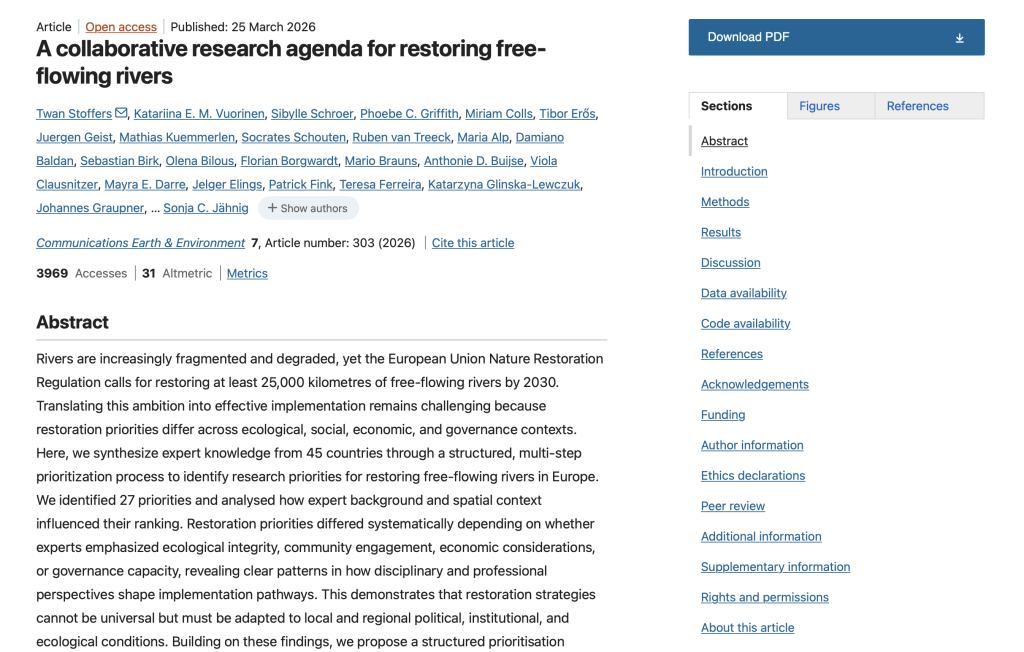
The recent article “A collaborative research agenda for restoring free-flowing rivers” lead by Twan Stoffers arrives at a critical moment for river science and policy in Europe. By synthesizing expert knowledge across 45 countries, we were able to identify 27 research priorities demonstrating that river restoration is not a purely technical task, but a fundamentally context-dependent socio-ecological process. We must consider that there is no “one-size-fits-all” principle in river restoration. Instead, priorities can diverge depending on whether actors emphasize ecological integrity, governance capacity, economic constraints, or societal engagement.
This finding resonates strongly with the reality of rivers in Austria and across the Danube Basin, where restoration is shaped by the interests of different sectors and actors. The Austrian Danube itself is a highly regulated system, interrupted by a cascade of dams, with only short free-flowing sections remaining, so the Austrian situation reflects the complexity highlighted in the paper very well as hydropower is a renewable energy source, floodplain restoration competes with agricultural and settlement interests and governance is multi-level, involving federal states, national authorities to implement EU directives.
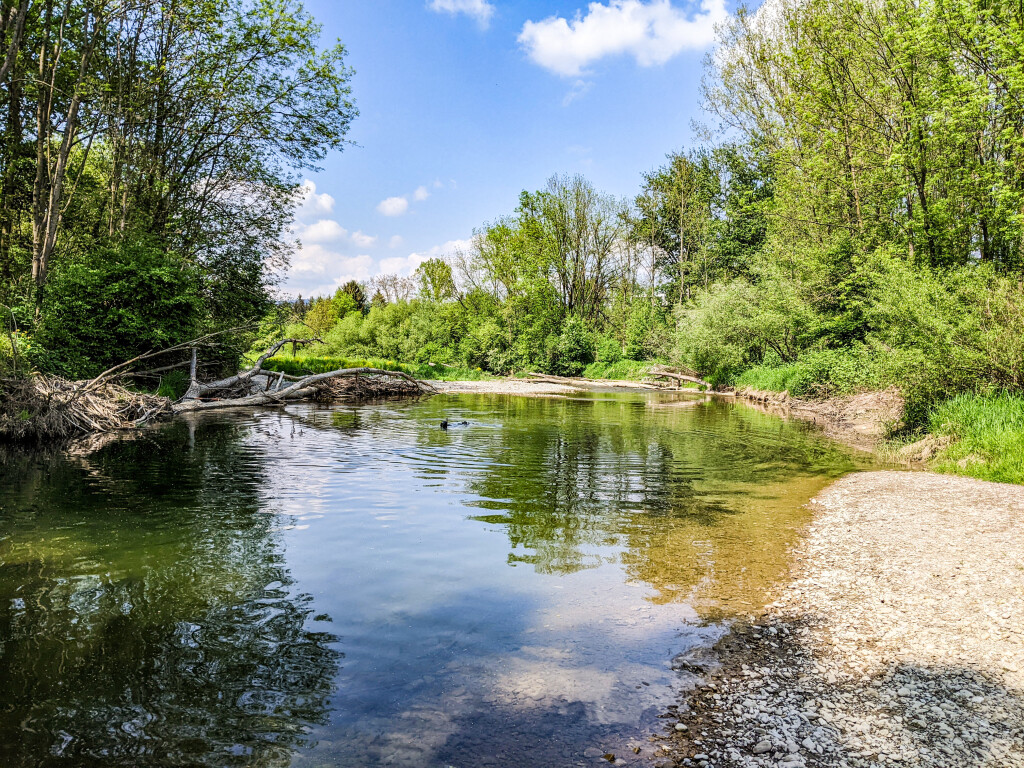
At the scale of the Danube River Basin, these challenges are amplified. Covering 19 countries, the basin embodies precisely the heterogeneity the article identifies: ecological conditions, institutional capacities, and societal values vary dramatically. Thus, the paper’s finding that disciplinary and regional perspectives shape restoration priorities is particularly visible here. Upstream countries often focus on hydromorphological pressures and hydropower optimization, while downstream regions may prioritize water quality improvements or sediment continuity. The Danube therefore exemplifies the need for adaptive, polycentric governance frameworks that can reconcile basin-wide goals with local realities.
One of the most important insights of the article is that restoring free-flowing rivers is not just about removing barriers, but about aligning ecological goals with social legitimacy and governance capacity. In Austria, this is increasingly evident in restoration projects along the Danube, such as floodplain reconnection efforts east of Vienna. These projects succeed not only because of ecological design, but because they integrate flood protection, recreation, and stakeholder engagement. The article reinforces that such integrative approaches are not optional: They are prerequisites for scaling up restoration to meet EU targets like restoring 25,000 km of free-flowing rivers by 2030.
Ultimately, the strength of this paper lies in bridging science and implementation. Its proposed framework linking connectivity, governance, and policy instruments reflects what many practitioners in the Danube region already experience: restoration succeeds where ecological ambition meets institutional feasibility. For Austria and the Danube River Basin, the message is clear. Achieving meaningful river restoration will depend less on identifying universal “best practices” and more on developing place-based strategies that navigate sectoral trade-offs and benefit biodiversity.
